Every Fitness Goal, Matched to What Actually Trains It
Summary
You have forty minutes, three decent options, and one aggressively unhelpful question: which workout is best? Your walking shoes are by the door.
You have forty minutes and a menu of walking, Pilates, lifting, intervals, and balance work. The useful question is not which workout is “best.” It is which adaptation you want to train.
Chapters
- 0:00The forty-minute decision
- 0:58Define the adaptation before ranking the workout
- 2:11Strength and bone need meaningful loading
- 4:59Endurance and balance improve when you practice them
- 7:11Body composition is two outcomes, not one promise
- 8:56Choose the goal, then choose the work
Transcript
Read the full transcript
You have forty minutes, three decent options, and one aggressively unhelpful question: which workout is best? Your walking shoes are by the door. The Pilates mat is already unrolled. The dumbbells are sitting there like they pay rent. Then your feed gives you five confident answers. Walk for fat loss. Do Pilates for long, lean muscles. Lift for strength and bones. Judging by the captions, it also comes with a whole new personality. Apparently one workout label can now answer every question your body has ever asked.
Your body does not read class titles. It adapts to the work you actually ask it to do. So stop asking which workout wins. Ask what you are trying to train, and whether this session provides that stimulus often enough, hard enough, and progressively enough to matter. Let’s match five common goals: strength, bone, endurance, balance, and body composition.
First, keep the outcomes separate. Strength is how much force you can produce. Muscle size is related, but it is not the same measurement. Bone density is another tissue outcome. Endurance is your ability to sustain aerobic work. Balance is a set of practiced movement skills. And body composition asks what portion of your mass is fat tissue and what portion is lean tissue. A workout can help several at once, but adaptations do not arrive as a matching set.
Choosing the walk is not a failed strength workout. It is an endurance session doing its own job. Lifting can build strength without covering all your aerobic work. A workout can be useful without being universal.
That is why current United States guidance includes both aerobic and muscle-strengthening activity. For general health, adults are advised to work toward one hundred fifty to three hundred minutes of moderate aerobic activity each week, plus strengthening on at least two days. Those are public-health ranges, not a personal report card. If you are starting from very little, a smaller amount that you can repeat is still a real start.
Goal one is strength. The direct tool is progressive resistance training. Progressive just means the challenge changes as you adapt. The exact tool is flexible. Bodyweight, bands, machines, and free weights can all work. Across women-only studies, resistance training produces substantial strength gains and measurable muscle growth. Heavier loads tend to be especially useful when maximal strength is the target, but a beginner does not need to turn Tuesday into one-repetition-maximum day.
Walking makes your muscles work. Pilates may improve strength or muscular endurance in some programs. But feeling challenged once is not the same as a plan that keeps challenging the muscle over time. This is the loop from muscle after thirty: age and menopause can affect your context and starting point, but adult women remain responsive to resistance training. The stimulus did not expire because a birthday happened.
Most progression is boring on camera: one more clean repetition, a little more resistance, or a harder version when you are ready. Boring is allowed. Your muscles do not need a montage.
Goal two is bone. Bone responds to mechanical loading, but it is picky about location and challenge. In studies of postmenopausal women, resistance training can preserve or modestly improve bone density at the spine and hip, although results vary by skeletal site and program. Appropriately progressed impact can add another kind of bone-loading signal when it is suitable for the person.
The word weight-bearing is not a magic stamp. Which bones are loaded, how demanding the load is, and whether the program continues all matter. Bone changes more slowly than post-workout soreness.
Walking is excellent aerobic activity, but walking-only programs have not reliably improved bone density at the spine or across the whole body in peri- and postmenopausal women. The limited Pilates trials have not established a significant bone-density benefit either. That is not an insult to walking or Pilates. It is simply the difference between a good activity and the most direct tool for a specific tissue.
Bone loading also has a real safety boundary. If you have diagnosed osteoporosis, a prior fragility fracture, a spine condition, or pain with loading, the rules can change. Get individual guidance before you add unfamiliar heavy or impact work, especially loaded bending or twisting. Exercise can support bone health. It does not replace an evaluation or prescribed treatment.
Goal three is endurance. Now purposeful aerobic work gets the starring role. Brisk walking is a standard example of moderate aerobic activity, and structured walking programs improve aerobic fitness in previously sedentary adults. The useful intensity is relative to you. A pace that feels easy for one person may be a genuine aerobic challenge for another.
Some studied Pilates programs also improve aerobic fitness. But Pilates varies enormously, so the class name cannot tell you how much aerobic work happened. The same is true of lifting. If endurance is your main goal, include training that actually asks you to sustain aerobic effort instead of making a strength session audition for a different job.
This is where the same exercise can change jobs. An easy walk may be recovery or daily movement. A faster, longer, or hillier walk may become aerobic training. The label stayed the same. The demand changed.
Goal four is balance. Balance is not one score that you either have or do not. Being steady in tree pose does not automatically make you better at catching a bad step off a curb. Standing on one leg, reacting to a trip, controlling a landing, and moving across uneven ground are different tasks. Research finds that people improve the balance tasks they practice, while the improvement may not transfer neatly to very different tasks.
Pilates can improve static and dynamic balance in older adults, but the evidence is not high certainty. It performs similarly to other exercise, and fewer falls have not been established. So Pilates can be one useful route, not the exclusive route. For older adults, current guidance specifically recommends balance work alongside aerobic and strengthening activity. Whatever your age, if balance is the goal, include a deliberate balance challenge rather than hoping it appears as a side effect.
Goal five is body composition, and this one needs two questions instead of one. Are you trying to support or increase lean mass? Resistance training is the direct tool. Are you trying to reduce fat mass? Aerobic work can contribute, and combining aerobic and resistance training can address both sides.
Across structured studies lasting at least ten weeks, aerobic training reduced more body mass and fat mass than resistance training on average, while resistance training retained more fat-free mass. Combined training can do both. But those are group averages, and the differences shrink when the total workload is matched. Pilates-specific body-composition evidence is sparse and conflicting. And training one body area does not give you reliable control over where fat is lost. Your triceps cannot forward a fat-loss request to the exact department you selected.
None of that makes body-composition change automatic. Those study results are group averages, not a promise about your particular Tuesday. A workout label cannot tell us whether your dose matched the research or whether the plan fit your life well enough to repeat. And it cannot promise a silhouette. If body composition matters to you, be clear which part you mean. Strength and fitness are valid outcomes in their own right.
You do not have to cram all five goals into one session like an overpacked carry-on. Emphasize one adaptation today and another later. The combination matters across a repeatable pattern, not inside every forty-minute block.
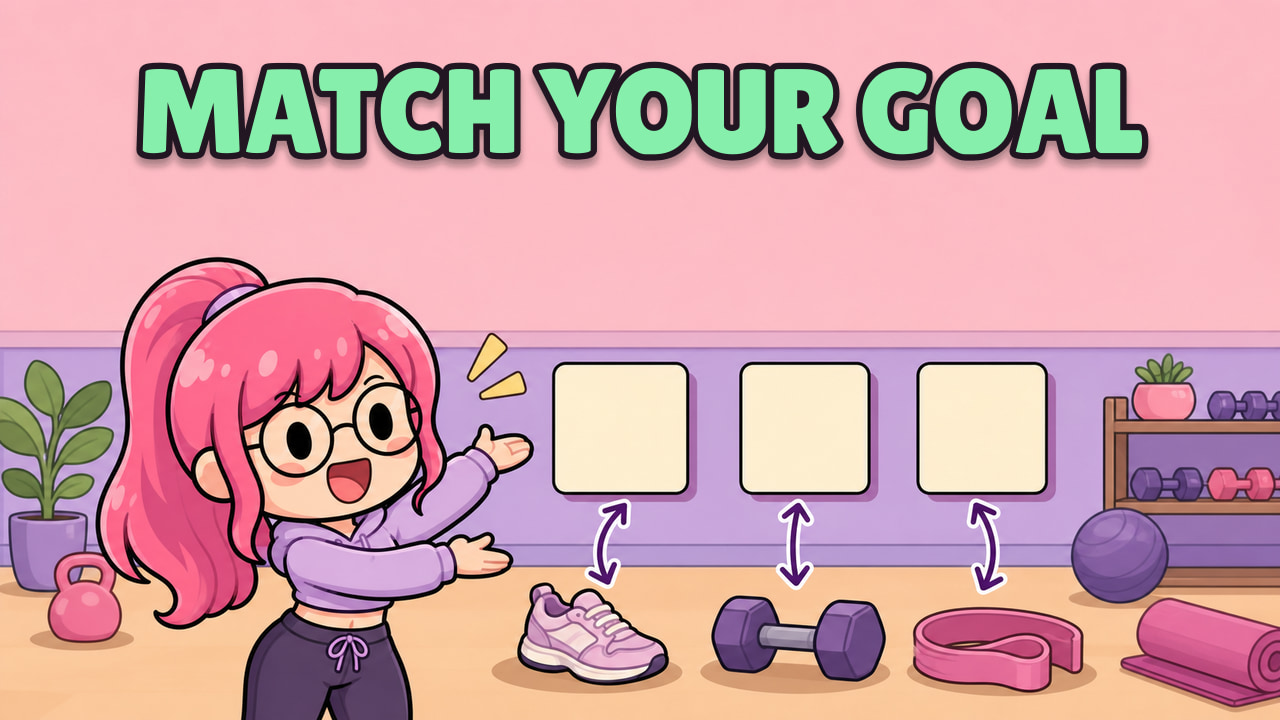
So here is the matcher. For strength, choose progressive resistance. For bone, include appropriate resistance and bone-loading work within your limits. For endurance, choose sustained aerobic work. For balance, practice balance deliberately. For body composition, separate lean mass from fat mass and consider a combination instead of asking one workout to do two different jobs.
Then add the part no chart can choose: what survives contact with your calendar, access, recovery, health, and preferences. Combining walking, Pilates, lifting, and dedicated balance work is not indecision. It is often exactly what a set of mixed goals requires.
Now you are back to those forty minutes. You do not need the universally best workout. You need to decide what today’s forty minutes are for, then choose a session that actually trains it. Choose the adaptation first. Then choose the work.
Sources & further reading
The claims in this episode are checked against these sources before publication. Evidence changes; if an important source is superseded, the entry gets updated and the date above changes.
- Physical Activity Guidelines for Americans, 2nd editionU.S. Department of Health and Human Services
- Resistance Training Prescription for Muscle Function, Hypertrophy, and Physical Performance in Healthy Adults: An Overview of ReviewsAmerican College of Sports Medicine / Medicine & Science in Sports & Exercise
- Top 10 Things to Know About the Second Edition of the Physical Activity Guidelines for AmericansOffice of Disease Prevention and Health Promotion, U.S. Department of Health and Human Services
- The Effect of Resistance Training in Women on Dynamic Strength and Muscular Hypertrophy: A Systematic Review with Meta-analysisSports Medicine
- Resistance training effects on healthy postmenopausal women: a systematic review with meta-analysisClimacteric / PubMed
- Optimal resistance training parameters for improving bone mineral density in postmenopausal women: a systematic review and meta-analysisJournal of Orthopaedic Surgery and Research
- Effects of walking on the preservation of bone mineral density in perimenopausal and postmenopausal women: a systematic review and meta-analysisMenopause
- Effects of Pilates Exercise on Bone Mineral Density in Postmenopausal Women: A Systematic Review and Meta-analysisJournal of Geriatric Physical Therapy
- Be Bone Strong: Weight-Bearing and Muscle-Strengthening ExercisesBone Health & Osteoporosis Foundation
- The effect of walking on fitness, fatness and resting blood pressure: a meta-analysis of randomised, controlled trialsPreventive Medicine
- Pilates Method Improves Cardiorespiratory Fitness: A Systematic Review and Meta-AnalysisJournal of Clinical Medicine
- Specificity of Balance Training in Healthy Individuals: A Systematic Review and Meta-AnalysisSports Medicine
- Effects of Pilates exercises on postural balance and reduced risk of falls in older adults: A systematic review and meta-analysisComplementary Therapies in Clinical Practice
- 10 Things to Know About the Physical Activity Guidelines Midcourse ReportOffice of Disease Prevention and Health Promotion, U.S. Department of Health and Human Services
- Comparison of concurrent, resistance, or aerobic training on body fat loss: a systematic review and meta-analysisJournal of the International Society of Sports Nutrition
- The Effects of Concurrent Training Versus Aerobic or Resistance Training Alone on Body Composition in Middle-Aged and Older Adults: A Systematic Review and Meta-AnalysisHealthcare
- Is the Pilates method efficient to cause changes in the body composition of healthy individuals? A systematic reviewJournal of Bodywork and Movement Therapies
- Regional fat changes induced by localized muscle endurance resistance trainingJournal of Strength and Conditioning Research
- Understanding Adults' Experiences and Perceptions of How to Maintain Physical Activity: A Systematic Review and Qualitative SynthesisInternational Journal of Behavioral Medicine
- Chronic Conditions & Disabilities ActivityCenters for Disease Control and Prevention
- Is Pilates better than other exercises at increasing muscle strength? A systematic reviewHeliyon
- Effect of the Pilates method on physical conditioning of healthy subjects: a systematic review and meta-analysisJournal of Sports Medicine and Physical Fitness
- High-Intensity Resistance and Impact Training Improves Bone Mineral Density and Physical Function in Postmenopausal Women With Osteopenia and Osteoporosis: The LIFTMOR Randomized Controlled TrialJournal of Bone and Mineral Research
Take the next step
Use The Her Body Baseline to compare your current mix of walking, Pilates, lifting, and recovery.