Every Level of Lifting for Women: Beginner to Advanced
Summary
You are standing in front of a dumbbell rack, trying to work out which version of lifting you are supposed to be doing. The beginner plan says tiny weights and perfect form.
The dumbbell rack makes strength training look like a ladder where everyone else knows which rung comes next. You do not need an advanced program to start—or to make progress.
Chapters
- 0:00The Dumbbell-Rack Decision
- 1:34Level One: First Reps
- 3:11Level Two: Repeatable Routine
- 5:11Level Three: Progressive Challenge
- 7:14Levels Four and Five: Specific, Then Advanced
- 11:41The Level That Serves You
Transcript
Read the full transcript
You are standing in front of a dumbbell rack, trying to work out which version of lifting you are supposed to be doing. The beginner plan says tiny weights and perfect form. The advanced plan has color-coded percentages, four kinds of squats, and a spreadsheet that looks ready to file taxes. Somewhere between them, the internet decided your level lives in the weight in your hand, the shape of your body, or how dramatically you collapse afterward.
That is not how levels work.
Your lifting level is not your age, your appearance, or your gym confidence. It is the amount of training experience you have, the skills you can repeat, and the programming detail your goal actually requires. A sixty-year-old learning her first row is a beginner. A thirty-year-old who has trained consistently for a decade may be advanced. Neither one is behind.
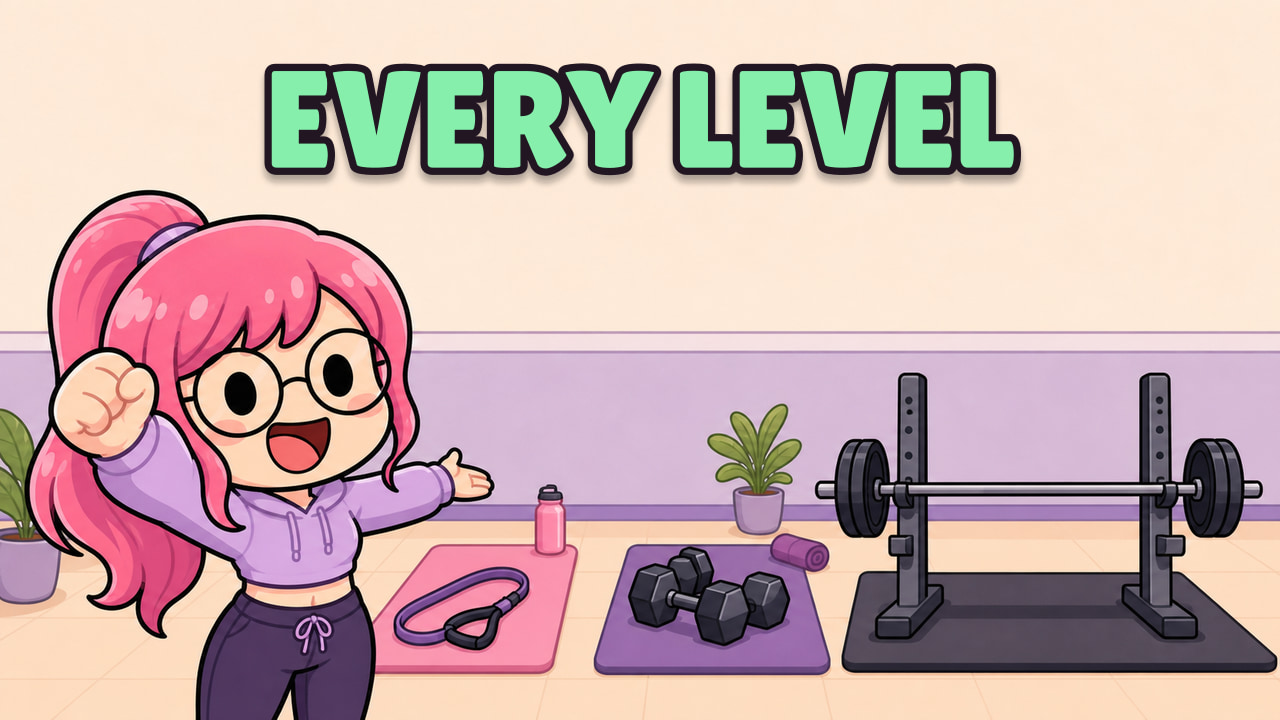
Here are the five levels: first reps, a routine you can actually repeat, progressive challenge, goal-specific training, and advanced programming. You are not supposed to race up them. The point is knowing what changes and what does not. The basics do not expire when you get stronger. They get more specific.
One thing before we start: advanced does not mean more worthy. You do not graduate from health because you never want to test a heavy lift. You can stay with a simple routine for years if it keeps serving the life you want. The ladder is a map, not a ranking of women.
Level One is the part where every machine has one mysterious lever and you keep checking whether the bench is bolted down. Underneath the awkwardness, you are learning what controlled effort feels like. Resistance training means making your muscles work against resistance, whether that resistance comes from dumbbells, machines, bands, or your own body weight.
So your first level does not require a barbell, a gym membership, or a sacred list of exercises. Choose a few movements you can control: sit and stand, push, pull, hinge, carry. Use a wall, a band, a machine, a dumbbell, or another manageable version. The job is not to collect exercises. It is to learn a version you can repeat next week.
Current U.S. guidance says adults should strengthen all major muscle groups on at least two days each week, and it also says some activity is better than none. That is a useful public-health starting point, not a test you fail if your first week contains one short session.
At this level, technique is not a beauty contest. It is a way to keep the movement controlled, repeatable, and appropriate for you. Adjust the range, the resistance, or the equipment when you need to. End the set before your form turns into interpretive dance. The goal is not to prove how much discomfort you can survive. It is to leave with information: what felt stable, what felt confusing, and what you can practice.
Level One works when you leave knowing what to repeat.
Level Two starts when the session stops being a random collection of exercises and becomes a routine. You cover your major muscle groups, return often enough to practice, and keep a simple note of what you did. Optimization can wait. You just need enough consistency to tell whether the plan is doing anything.
Across randomized trials in healthy adults, resistance training improves strength and muscle size, and it can improve physical function. Women are not a footnote in that story. A 2026 review of one hundred twenty-six studies involving just over four thousand healthy women found substantial strength gains in both premenopausal and postmenopausal women, while average changes in lean or muscle mass were smaller.
Notice the split. Strength, muscle size, and appearance are not the same outcome. Early strength gains are not a trick: practice, coordination, and other nervous-system adaptations can improve how well you use the muscle you already have, while muscle growth builds over repeated training.
So if the grocery bag stops demanding a mid-hallway hand swap before anything looks different, the program is not failing. Your body learned the task. That is an adaptation, even if it does not come with a dramatic reveal.
Your record at this level can stay gloriously boring. Write down the exercise, the resistance or variation, and roughly what you completed. There is no need to score every sensation. You need enough information to avoid restarting from memory every Monday.
Level Two is also where consistency stops meaning perfection. A routine that survives travel, work, caregiving, low-energy days, and ordinary chaos beats a flawless plan that only works in a laboratory with excellent parking. Now you have a routine built for your real week.
Level Three begins when repeating the same work is no longer enough to keep moving toward your goal. Now you need progressive challenge.
Progressive overload means the work becomes more demanding over time. That can come from more resistance, more repetitions, more sets, a larger controlled range of motion, or better execution. It does not mean adding weight every workout forever. Bodies are not phone plans. You do not receive a guaranteed upgrade on Tuesday.
Choose one useful change when the current version has become comfortably manageable. Maybe you use a slightly heavier dumbbell. Maybe you keep the weight and complete another controlled repetition. Maybe you control a range that used to feel wobbly. Progress is a direction across time, not a demand that every session beat the last one.
Now your goal gets a vote. Heavier loads tend to produce the largest gains in maximal strength, while a wide range of loads can build muscle when the work is challenging enough. If you want to improve a heavy lift, practicing heavier work becomes more relevant. If your goal is muscle growth, lighter or moderate loads can still work. The dumbbell color does not know your goal.
Your timeline also refuses to be standardized. Responses vary widely even when previously untrained adults follow the same program, so one person’s progress is not a deadline for yours.
Do you need to take every set to complete failure now? No. Do you need to replace your dumbbells with a machine, then replace the machine with a barbell, like some sort of equipment-based evolution chart? Also no. Training to complete failure, using one special type of equipment, and complex periodization have not consistently improved results for the average healthy adult.
Those tools may be useful. They are still not graduation requirements. At Level Three, you can explain what you changed and why.
Level Four is goal-specific training. Up to this point, one sensible routine could improve several things at once. Now your goal gets precise. Maybe you want a stronger squat, more muscle, better performance in a sport, more confidence carrying luggage, or a loading plan that supports bone health. Those goals overlap, but they are not identical.
Strength is specific enough that advanced programming should follow the task or outcome you want to improve, rather than chasing complexity for its own sake. You keep the exercises and training details that serve the goal. You stop adding techniques merely because someone called them advanced in capital letters.
Volume is one example. For healthy adults, higher weekly volume tends to produce more muscle growth; ten or more weekly sets per muscle group enhanced hypertrophy on average in the 2026 ACSM review, but the authors could not determine one optimal number for everyone. That number matters if maximizing muscle growth is your goal. It is not a command for every woman to count ten sets for every muscle tomorrow. Extra volume has to serve your goal instead of merely increasing your set count.
Protein is support, not a level. Protein supports training rather than replacing it: across forty-nine trials, adding protein during prolonged resistance training produced small average extra gains in fat-free mass, muscle size, and strength. For most exercising adults, a daily protein range around one point four to two grams per kilogram is sufficient to build or maintain muscle, but that is a general range, not a required target for every woman.
You do not become advanced by buying powder. Neither a scoop nor a meal performs a deadlift on your behalf. If that general range does not fit your health or your relationship with food, use individualized guidance instead of an internet target.
Bone is another goal that needs its own rules. Resistance training can help preserve or modestly improve bone density at the spine and hip in postmenopausal women, but the effects are site-specific and the evidence is more limited than the muscle and strength evidence. The program that makes one lift stronger is not automatically the perfect bone program.
Here the general ladder stops. If you have osteoporosis, a previous fragility fracture, or a high fracture risk, high-impact work and some loaded bending positions may need modification, so your program should be cleared and taught by a qualified clinician or physical therapist. Supervised research protocols are not dares.
Level Five is advanced programming. It is not a different species of exercise. You still apply resistance, recover, and repeat. The upgrade is feedback. With enough training history and a specific goal, you can track performance, weekly volume, exercise selection, and recovery more closely. You might plan harder and easier periods or change an exercise when progress stalls. Each detail should solve a problem you can name.
That is why a complicated plan can be appropriate for one advanced lifter and decorative nonsense for another. Complexity is a tool. If it does not improve the decision, it is just admin wearing gym clothes.
Your age does not assign your training level: women across adulthood, including postmenopausal women, can improve strength with resistance training. Age and life stage may change your starting point, recovery, health considerations, or priorities. They do not automatically place you at Level One, and they do not disqualify you from progress.
Pregnancy, postpartum recovery, active injury, and some health conditions can change what is safe, so this general ladder is not an individualized return-to-training plan. And sudden weakness, weakness in one area, or weakness that does not go away without a clear reason deserves medical evaluation rather than a harder workout.
That is what advanced finally means: knowing which outcome you are training, which feedback matters, and which extra details you can ignore.
So you are back at the rack. The small dumbbell is not automatically beginner equipment. The barbell is not automatically advanced. The spreadsheet is not proof of expertise, and sweat on the floor is not a certificate.
At Level One, you learn. At Level Two, you repeat. At Level Three, you progress. At Level Four, you choose a specific outcome. At Level Five, you refine the plan with better feedback. At every level, the work still has to be controllable, repeatable, challenging enough for your goal, and compatible with the rest of your life.
General health is a valid destination. So is specializing because a particular goal delights you. And when life changes, simplifying is allowed. Moving down a rung is not failure. Sometimes it is exactly what keeps you training.
The best next level is not the one that looks most impressive online. It is the smallest useful change your current training has earned. Pick the weight you can control. Write down what you did. Then give yourself enough time to learn what actually needs to change.
Which level feels most like your training right now: learning, repeating, progressing, specializing, or refining?
Sources & further reading
The claims in this episode are checked against these sources before publication. Evidence changes; if an important source is superseded, the entry gets updated and the date above changes.
- American College of Sports Medicine Position Stand. Resistance Training Prescription for Muscle Function, Hypertrophy, and Physical Performance in Healthy Adults: An Overview of ReviewsAmerican College of Sports Medicine / Medicine & Science in Sports & Exercise
- Top 10 Things to Know About the Second Edition of the Physical Activity Guidelines for AmericansOffice of Disease Prevention and Health Promotion, U.S. Department of Health and Human Services
- Resistance training prescription for muscle strength and hypertrophy in healthy adults: a systematic review and Bayesian network meta-analysisBritish Journal of Sports Medicine
- It's never too late: The impact of resistance training on strength and body composition in females across the lifespan — A systematic review and meta-analysisJournal of Science and Medicine in Sport
- Resistance Training Induced Changes in Strength and Specific Force at the Fiber and Whole Muscle Level: A Meta-AnalysisEuropean Journal of Applied Physiology
- 5 Things to Know About the Resistance Training Position StandAmerican College of Sports Medicine
- Heterogeneity in resistance training-induced muscle strength and mass responses in men and women of different agesAge
- Task Specificity of Dynamic Resistance Training and Its Transferability to Non-trained Isometric Muscle Strength: A Systematic Review with Meta-analysisSports Medicine / PubMed
- A systematic review, meta-analysis and meta-regression of the effect of protein supplementation on resistance training-induced gains in muscle mass and strength in healthy adultsBritish Journal of Sports Medicine
- International Society of Sports Nutrition Position Stand: protein and exerciseJournal of the International Society of Sports Nutrition
- Optimal resistance training parameters for improving bone mineral density in postmenopausal women: a systematic review and meta-analysisJournal of Orthopaedic Surgery and Research
- Be Bone Strong — Weight-Bearing and Muscle-Strengthening ExercisesBone Health & Osteoporosis Foundation
- Physical Activity Guidelines for Americans, 2nd editionU.S. Department of Health and Human Services
- WeaknessMedlinePlus, U.S. National Library of Medicine
Take the next step
Start with The Her Body Baseline to see where strength training currently fits into your week.