The Period Weight Gain Nobody Warns You About
Summary
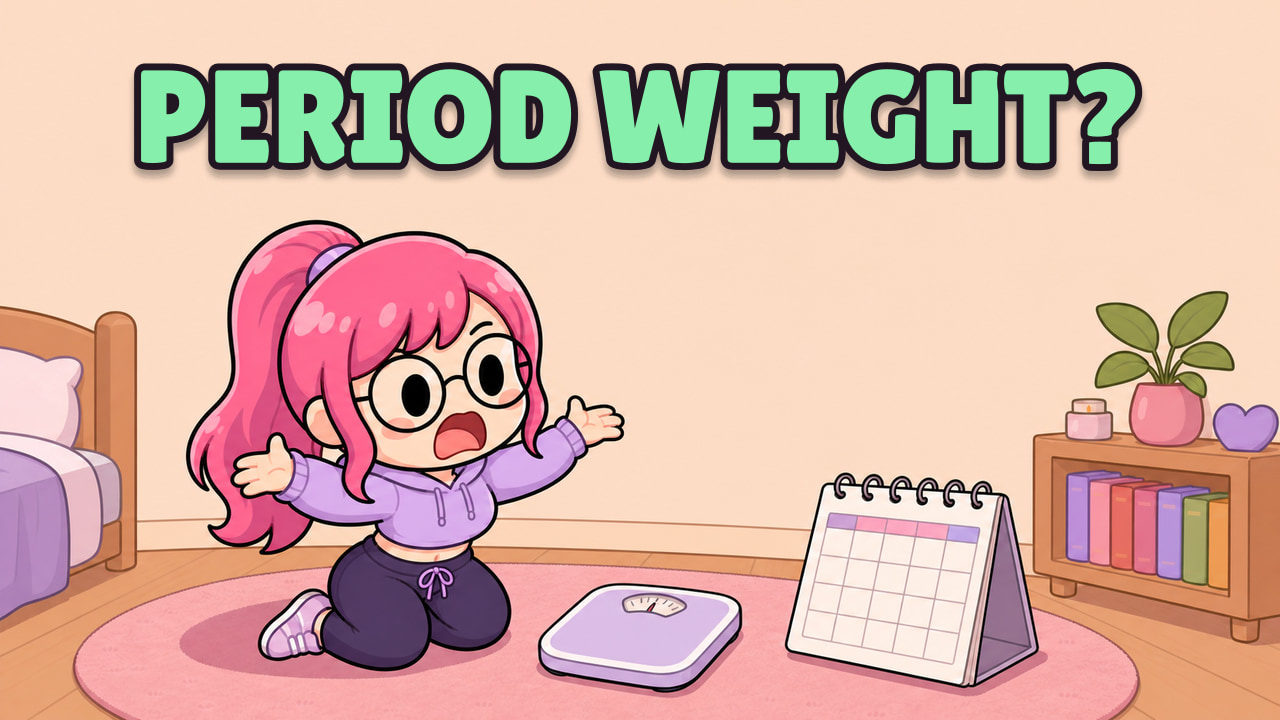
It's the night before your period, and you step on the scale, and the number is up two pounds. And you just stand there for a second, because it honestly doesn't make sense.
The scale jumps around your period, your rings feel tighter, and your jeans suddenly want to negotiate. It can feel like your body changed overnight—even when your routine did not.
Chapters
- 0:00The number that shows up overnight
- 1:17What a scale can and cannot tell you
- 2:29Where the extra actually comes from
- 4:31Why the pattern is different for everyone
- 6:04What to do, and when to check in
- 7:33The number is a visitor, not a verdict
Transcript
Read the full transcript
It's the night before your period, and you step on the scale, and the number is up two pounds. And you just stand there for a second, because it honestly doesn't make sense. You didn't eat differently. You didn't skip your workout. If anything, you were careful this week. But there it is. Your rings feel a little tight, your waistband is leaving a mark, and your favorite jeans have turned into a negotiation. So you do the thing almost everyone does. You turn sideways in the mirror, you replay everything you ate yesterday, and somewhere in the back of your mind, a quiet voice starts building a case against you. Maybe you even think about changing your outfit, or quietly talk yourself out of a plan, all because of a number that has been on the scale for about ten seconds. And it does not help that half your feed is ready to call it weight gain and sell you a fix for it. So if you take one thing from the next few minutes, let it be this. The scale really can climb in the days around your period. But most of what it's showing you is water and the state of your gut, not fat. And those two things could not be more different. So before you let a single number rewrite how you feel about your whole body, let's slow down and look at what's actually happening.
Start with what a scale can genuinely tell you, because it's less than you'd think. A scale measures total mass, all of it at once. Your bones, your muscle, your organs, the dinner still working its way through you, and every bit of water you happen to be holding in that moment. What it cannot do, not even a little, is tell you what that weight is actually made of. And that's the whole problem, because fat and fluid get squashed into the same scary number, even though they behave nothing alike. So here's the part that almost never makes it into the panic. A jump of two or three pounds overnight is basically never fat. Actually building a pound of body fat takes a real, steady calorie surplus, stacked up over weeks, not over a single evening. Your body simply can't create fat that fast, no matter what the scale seems to be implying. So when the number spikes overnight, the timing alone is your first clue. That overnight number is a lot of things at once, but it almost certainly isn't the one thing you're afraid of. Whatever showed up that quickly came from something far more temporary than fat could ever be.
So if it isn't fat, then what is it? Start with fluid, because it's the biggest piece by far. All month long, your estrogen and progesterone are rising and falling, and those swings quietly tug on the systems that manage salt and water in your body. When that balance shifts, you hold onto a little more water than usual. That's why, on some days, your hands feel puffy, your rings stick, and the scale drifts up for no obvious reason. That is fluid moving around. It is not fat arriving overnight. Think of it as your body briefly holding a little extra water, the way a sponge does, and then quietly letting it go again. And honestly, the real size of this is smaller than the internet wants you to believe. When researchers actually weighed people across the cycle, body weight was only about a pound higher around their period, and they traced that little bump straight to water, not to fat. You'll see much scarier numbers online, whole ranges of pounds, but those tend to come from people guessing, not from anyone carefully measuring. Then there's the second piece, which is your gut. Bloating and gas are some of the most common complaints in the days before a period, and a full, distended belly can absolutely change how your clothes sit, even when your actual weight has barely moved. By the evening, you might just feel bloated and heavy, like everything you ate is still sitting there. Though here's the honest part, the studies genuinely disagree about exactly when in the cycle bloating peaks, so this is real, but a lot messier than a tidy little infographic makes it look. And then there's appetite. On average, some people do get a bit hungrier in the two weeks before their period, somewhere around a hundred to two hundred extra calories a day in the research. But the range is enormous, from no change at all to quite a lot more. That's a soft average across a whole group. It is not a rule about you, and it is definitely not proof that you lack willpower.
Which brings us to the word that matters most in all of this: variation. More than ninety percent of women notice some premenstrual symptom at some point, but for most people it stays mild, and plenty of people feel no real weight or bloating change at all. None of this is a schedule your body ever signed up to follow. And it means that one single cycle tells you almost nothing. Remember, a scale is a genuinely noisy instrument. It moves with how much water you drank, how salty last night's dinner was, whether you've been to the bathroom yet, and even the time of day you happen to step on it. Weigh yourself at the gym instead of at home, on a totally different scale, and you can watch a pound or two appear out of nowhere, with your cycle nowhere in the picture. Now layer a normal cycle on top of all that, and a two pound morning is completely boring and expected. If you want a number that actually means something, compare the same point in your cycle from one month to the next, instead of spiraling over a single Tuesday. And if you're on hormonal birth control, your pattern might look different again, because the pill shifts the hormonal rhythm underneath all of this. For what it's worth, the pill itself isn't an established cause of lasting weight gain. And the most reassuring part is how quickly the fluid piece lets go. It usually settles on its own within a few days of your period starting, without you doing a single thing to chase it away.
So what are you actually supposed to do with all of this? Honestly, far less than the internet would have you believe. If you weigh yourself at all, try to treat any one day as noise, not breaking news, and remind yourself that the pre-period bump tends to leave on its own. There is nothing here to punish yourself for, nothing to offset, and nothing to correct. Your body is doing something completely ordinary, and it is already handling it. You do not owe anyone a smaller number by the weekend, and you do not owe your own body an apology for doing exactly what bodies are built to do. That said, not every weight change is your cycle, and a few patterns really are worth a professional's eyes. If the scale climbs quickly and then just stays up, clearly outside your normal monthly rhythm, that's worth getting checked. If weight gain shows up alongside swelling in your legs, ankles, or belly, please get it looked at, because that kind of fluid can point to something beyond your period. And if bloating turns severe, or painful, or stops tracking with your cycle at all, that deserves attention too. One more. If your premenstrual symptoms are heavy enough to genuinely disrupt your life, including a more severe form called premenstrual dysphoric disorder, that's a conversation to bring to a professional, not something you have to white-knuckle alone.
So let's go back to that night. The tight jeans, the higher number, the little voice getting louder. This time, read the scene differently. Almost everything you're seeing is water your body is briefly holding, plus a gut that simply feels full, both sitting on top of a totally normal hormonal shift. It showed up fast, which is exactly why it isn't fat, and it will very likely leave the same quiet way it came, on its own, within a few days. Your weight is allowed to move. It moves every single day, period or no period. The you from two weeks ago and the you standing on the scale tonight are the same person, in the same body, on a slightly different day of the month. A number that visits for a few days and then slips away is not a report card on your worth, your discipline, or how hard you have worked. It is just your body doing the small, unglamorous, temporary things that living bodies quietly do. And once you can tell that difference, you get to step off the scale, let the number go, and get back to your actual life.
Sources & further reading
The claims in this episode are checked against these sources before publication. Evidence changes; if an important source is superseded, the entry gets updated and the date above changes.
- Premenstrual Syndrome (PMS)Merck Manual Consumer Version
- Premenstrual syndrome (PMS)US Office on Women's Health
- Changes in body weight and body composition during the menstrual cycleAmerican Journal of Human Biology (Kanellakis et al.)
- Gastrointestinal functioning and menstrual cycle phase in emerging young adult women: a cross-sectional studyBMC Gastroenterology (Mendelson et al.)
- The Effect of the Menstrual Cycle on Energy Intake: A Systematic Review and Meta-analysisNutrition Reviews (Tucker et al.)
- Combination contraceptives: effects on weightCochrane Database of Systematic Reviews (Gallo et al., CD003987) with FSRH guidance
- Unexplained Weight GainCleveland Clinic
Take the next step
Short-term changes make more sense with a week of context. Use The Her Body Baseline to observe movement, energy, sleep, and recovery over seven days.