What Birth Control Can—and Can't—Change About Your Body
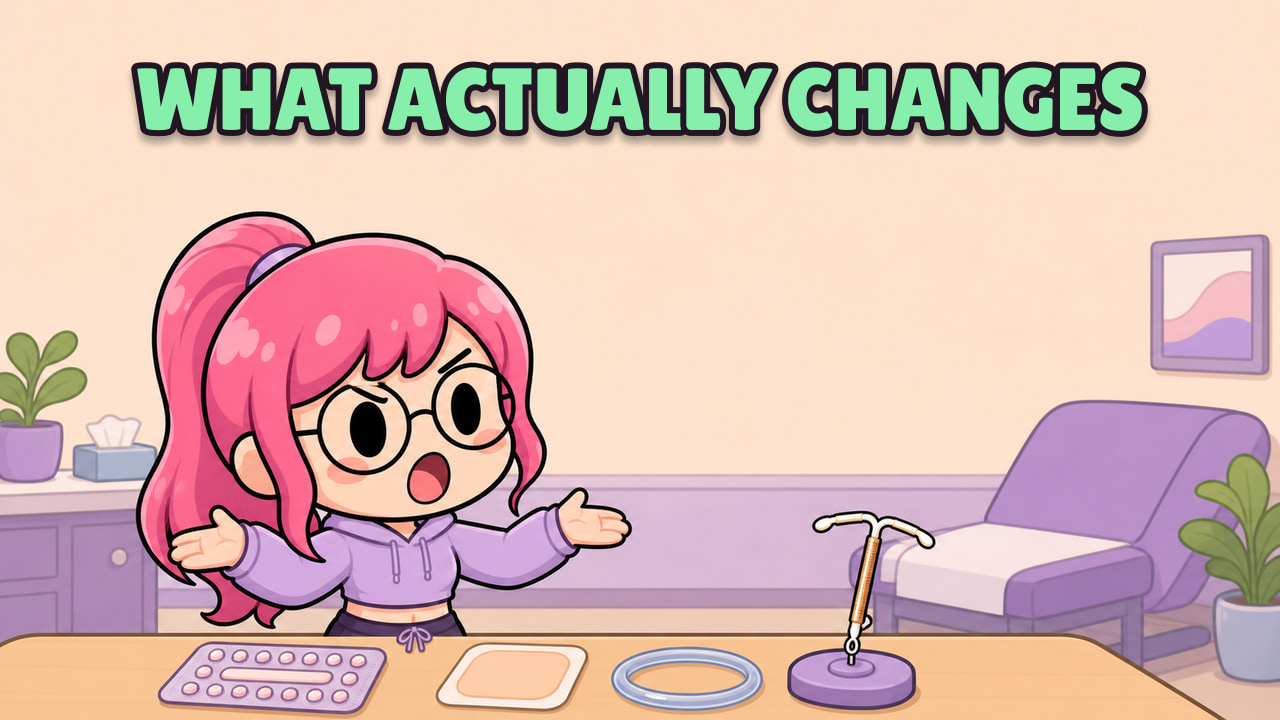
Summary
You're sitting on the edge of your bed, phone in hand, with two opposite tabs open. One woman says birth control changed her whole body.
One person says birth control changed her whole body. Another says it cannot change anything except pregnancy risk. Both claims skip the most important detail: which method?
Chapters
- 0:00The two-tab panic
- 0:35The method name matters
- 1:37The change you can see most clearly
- 3:04Weight, shape, breasts, and skin
- 5:03Mood, bone, fertility, and safety
- 8:01A better comparison
Transcript
Read the full transcript
You're sitting on the edge of your bed, phone in hand, with two opposite tabs open. One woman says birth control changed her whole body. Another says it can't possibly change anything except pregnancy risk. You're not here to referee the comment section. You just want to know what might change for you.
Both posts are too broad. What happens depends on the exact method, the change, and the time frame. Birth control isn't one drug. It is several very different methods that the internet keeps stuffing into one trench coat. We'll sort out what the evidence supports, what varies by method, and what gets oversold online.
First, these methods are not interchangeable. The combined pill, patch, and ring contain estrogen plus a progestin. The progestin-only pill, implant, injection, and hormonal IUD do not contain estrogen. The copper IUD contains no hormone at all. Those differences shape bleeding, side effects, and who can use each method safely.
If a side-effect list has ever left you confused, here is the catch. A symptom on a product label means it was reported. It doesn't prove the method caused every case or predict what will happen to you. Trials, labels, and personal stories answer different questions. Someone else's experience can be completely real without becoming your forecast. Timing still matters. A change that starts after a new method is worth noticing, but sequence alone doesn't prove cause. It gives you a useful question for a clinician or pharmacist, not a diagnosis you must make yourself.
Bleeding is often the clearest body change, but the direction depends on the method. With a hormonal IUD, spotting or light bleeding is expected during the first three to six months. Over time, bleeding generally decreases, and some users have very light bleeding or no bleeding. Expected doesn't mean convenient. It means the first few months may not look like the pattern you end up with.
With the implant, spotting or light bleeding is common, and some users have no bleeding. Heavy bleeding is uncommon. The pattern may settle with time, or it may not. The contraceptive injection can cause irregular or unpredictable bleeding at first, while no bleeding becomes more common with continued use. Even on the same method, two users can end up with quite different calendars.
Then there is the copper IUD. It contains no hormone, but it can make periods heavier or longer and increase spotting or cramping. Nonhormonal doesn't mean nothing changes. Combined pills can create scheduled withdrawal bleeding, while extended or continuous regimens can make bleeding less frequent. Spotting can still happen. So you might hear that one person stopped bleeding while another bled more. Neither story tells you what all birth control does until you know the method. The same bleeding change can feel different depending on what you wanted. Lighter bleeding may bring relief to one person and feel unsettling to another. Your preference matters too.
Now for the tab you may have clicked first: weight. For combined pills and patches, trials have not shown a large causal effect on weight. They also can't rule out every individual change. Both facts matter. No large average effect is not the same as telling you that a change you noticed is imaginary.
For progestin-only pills, implants, and hormonal IUDs, the overall weight evidence is limited and low quality. Most studies found small average changes and no clear difference from comparison groups. The shot stands apart. It has a clearer average weight-gain signal than most other methods, but the amount varies too widely to predict yours. That's a reason to treat the shot separately, not a promise that you will gain weight.
Weight isn't the same thing as body shape. The evidence doesn't show that hormonal birth control reliably moves fat to your hips, permanently enlarges your breasts, or builds a predictable new silhouette. Breast tenderness can happen with combined pills. That can feel like a body change without proving permanent breast growth or fat redistribution. Birth control isn't a body-editing app, no matter how polished the before-and-after looks.
Skin is another place where the method name matters. Some combined pills reduce both inflamed and noninflamed facial acne compared with placebo. Acne is also reported by implant and hormonal-IUD users. So the useful question is not whether birth control clears skin. It is which method and formulation you are talking about. The pill that helped a friend's acne doesn't tell you what an implant or IUD will do. Not every possible change has to matter equally to you. Clearer skin may matter a lot to one person, while bleeding patterns or future fertility matter more to someone else. A comparison becomes useful when it includes why you wanted contraception in the first place.
Mood is where a reassuring average can feel especially unhelpful. In randomized trials, hormonal contraception did not worsen depressive symptoms in adult women on average. But young first-time users were underrepresented, and an average can't predict your response. So neither extreme holds up. Birth control doesn't automatically cause depression, and a new mood change still deserves attention. The choice isn't between believing every symptom is caused by the method and pretending your experience doesn't matter.
The shot has one more warning that doesn't belong to every method. It can lower bone mineral density. The loss increases with longer use, may not fully reverse, and its effect on later fracture risk remains uncertain. That's a specific tradeoff to discuss, not a warning label for every hormonal method.
Permanent infertility is one of the scarier claims you may see. Current evidence doesn't support claims that pills, implants, or IUDs cause permanent infertility. Return to ovulation and conception can still differ by method. After implant removal, fertility can return quickly. The shot can delay return to ovulation and conception after the last injection. A study median isn't a deadline for your body, and neither finding can predict when you will conceive. If future pregnancy matters to you, ask how quickly fertility usually returns after the method you are considering.
Then there is a question no side-effect ranking can answer. Is this method appropriate for your medical history? Combined methods, which contain estrogen, can raise the risk of blood clots and certain cardiovascular problems and aren't appropriate for some people. That can include people with migraine with aura, severe hypertension, or a history of blood clots, as well as people who smoke at age thirty-five or older. Choosing birth control isn't just shopping for the shortest side-effect list. A useful conversation includes your medical history, pregnancy-prevention priorities, and the tradeoffs you actually care about. An eligibility warning isn't a moral grade or a declaration that the method is bad. It means risk changes with the person and context.
Sudden shortness of breath, chest pain, coughing blood, fainting, or a painful swollen leg can signal a clot or pulmonary embolism. If any of those symptoms happen, get emergency care. Heavy or prolonged bleeding, severe pelvic pain, fever, or unusual discharge deserve prompt clinical attention. So do suspected pregnancy or a major new mood change. Don't automatically chalk any of them up to birth control. And the hormonal methods and IUDs in this video don't protect against HIV or other sexually transmitted infections. Condoms can add that protection.
Go back to those two open tabs. You can stop trying to decide which stranger online is correct. Name the exact method first. Then ask what changed, when it started, and how severe it is. What matters most to you about bleeding, skin, pregnancy prevention, convenience, or future fertility? How does your health history change the tradeoffs? Those questions are less dramatic and far more likely to get you a useful answer. If you are preparing for an appointment, you do not need a perfect theory. Bring the method name and when the change began. Note whether it is improving or worsening, how much it affects you, and what you want from contraception. That gives the conversation something more useful than saying the internet promised it would never happen.
Now those tabs make more sense. Birth control can change parts of your experience, especially bleeding. Some effects matter enough to plan around, and certain symptoms need medical attention. It can't promise a new body or predict a ruined one. The loudest story online shouldn't make the decision for you. You can compare the actual method with the change you care about, then leave room for your own experience and priorities to count. If you have been through this decision, what is one method-specific question you wish someone had answered clearly?
Sources & further reading
The claims in this episode are checked against these sources before publication. Evidence changes; if an important source is superseded, the entry gets updated and the date above changes.
- U.S. Selected Practice Recommendations for Contraceptive Use, 2024Centers for Disease Control and Prevention
- Contraception and Birth Control MethodsCenters for Disease Control and Prevention
- Nexplanon prescribing informationDailyMed, U.S. National Library of Medicine
- Depo-Provera CI prescribing informationDailyMed, U.S. National Library of Medicine
- Birth Control GuideU.S. Food and Drug Administration Office of Women's Health
- Mirena prescribing informationDailyMed, U.S. National Library of Medicine
- Paragard prescribing informationDailyMed, U.S. National Library of Medicine
- Norgestimate and ethinyl estradiol tablets prescribing informationDailyMed, U.S. National Library of Medicine
- Combination contraceptives: effects on weightCochrane Database of Systematic Reviews
- Progestin-only contraceptives: effects on weightCochrane Database of Systematic Reviews
- Weight change among women using intramuscular DMPA, a copper IUD, or a levonorgestrel implant for contraceptioneClinicalMedicine
- Combined oral contraceptive pills for treatment of acneCochrane Database of Systematic Reviews
- Hormonal contraceptive use and depressive symptoms: systematic review and network meta-analysis of randomised trialsBJPsych Open
- Return of fertility after discontinuation of contraception: a systematic review and meta-analysisContraception and Reproductive Medicine
- U.S. Medical Eligibility Criteria for Contraceptive Use, 2024Centers for Disease Control and Prevention
- Pulmonary EmbolismMedlinePlus, U.S. National Library of Medicine
- Deep Vein ThrombosisMedlinePlus, U.S. National Library of Medicine
Take the next step
General education pairs well with self-observation. The Her Body Baseline is a seven-day check-in — not a diagnostic tool.