Women's Supplements, Ranked: What's Worth It and What's Marketing
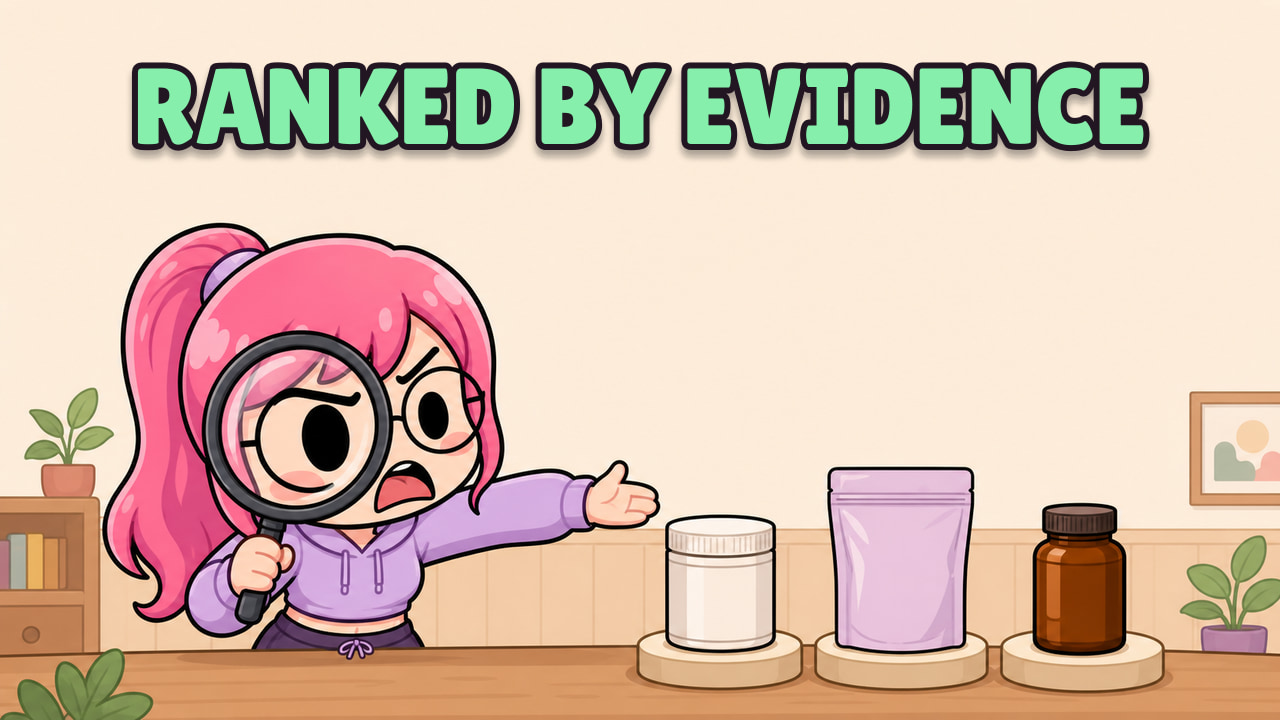
Summary
You open one innocent supplement page, and twenty minutes later your cart contains a muscle powder, a protein shake, an iron bottle, and something promising hormone harmony in a font that looks spiritually expensive.
Your supplement cart contains creatine, protein powder, iron, and something promising to “balance hormones.” They do not belong in one evidence tier—or in one safety conversation.
Chapters
- 0:00Your cart needs a ranking rule
- 1:09S tier with an asterisk: creatine monohydrate
- 2:49A tier: protein powder
- 4:17C tier, meaning conditional: iron
- 6:17F tier: “hormone-balancing” products
- 8:34Your four-question filter
Transcript
Read the full transcript
You open one innocent supplement page, and twenty minutes later your cart contains a muscle powder, a protein shake, an iron bottle, and something promising hormone harmony in a font that looks spiritually expensive.
So let's rank them. But first, one rule: “can this work somewhere?” is not the same as “does it deserve space beside your coffee maker?” We are ranking usefulness for the person holding the credit card. Is there good human evidence for a specific outcome? Does that outcome apply to you? Can you decide safely without a test or clinician?
That immediately scrambles the shelf. Iron can be an excellent treatment and a bad just-in-case purchase. Protein can be essential while protein powder remains optional. And a supplement can affect biology without proving the glossy promise on the front.
This ranking is not a personality test. Using a convenient product is not lazy. Needing treatment is not failure. Skipping a supplement is not purity. The only thing getting graded is the distance between a claim and the evidence supporting it.
Plain creatine monohydrate goes in S tier, with an asterisk the size of a gym bag. For a resistance-training or repeated high-intensity goal, plain creatine monohydrate has the strongest evidence of these four categories.
Across the broader research, creatine can improve strength, power, repeated high-intensity effort, and adaptations to training. It has little value for endurance-only performance. That is a job description, not a universal upgrade.
Now for the asterisk. In active women specifically, a 2025 review found that most included studies showed no performance improvement over placebo, and the small, inconsistent evidence base could not settle who benefits. Women were not absent from creatine research, but the confident internet version is tidier than the direct evidence.
So S means strongest in this cart for the right training goal, not mandatory for womanhood. Creatine monohydrate is the form with the established research base; a more futuristic label does not establish a better result.
Creatine can move the scale because it can increase water retention. That known effect is not evidence that it burned fat or changed your hormones. Creatine is not a fat burner, a hormone-balancing product, or a replacement for training.
And a high tier is not your personal medical clearance. Pregnancy does not yet have enough human supplementation evidence for a general creatine recommendation, and kidney disease or medication questions belong with your clinician.
Protein powder lands in A tier: useful, unglamorous, and wildly over-accessorized. Protein powder is a convenient way to add protein when food is inconvenient, not a uniquely powerful kind of protein.
You can meet protein needs through food, so powder is useful only when it solves a real gap or convenience problem. Maybe it is 8:07, you are already late, and breakfast lost the scheduling meeting. Maybe appetite is low, or the meal you have is light on protein. That is a practical use. It is not a moral upgrade over whichever protein-rich foods already work in your diet.
If food already covers what you need, buying powder does not unlock a hidden second level of protein. You are choosing format, flavor, price, and convenience. The physiology does not award bonus points because your snack came with a scoop.
Protein supplies raw material, but using your muscles provides the training signal, so a shake by itself does not build strength. The powder can support a plan. It cannot become the plan while your dumbbells gather emotional dust.
There is no single women-only protein number. Needs change with body size and age, activity and goals, total diet and health, and pregnancy. Kidney disease and pregnancy can change appropriate protein intake, so those are individualized-care questions, not reasons to copy a number from a tub.
A-tier verdict: useful tool, optional product.
Iron goes in C tier, and here C means conditional, not mediocre. Iron is part of hemoglobin, which carries oxygen, and iron deficiency can progress from depleted stores to iron-deficiency anemia. When iron deficiency is confirmed, replacing iron is evidence-based treatment.
The trap is treating a symptom like a lab result. Low iron can show up as fatigue, weakness, poor concentration, feeling cold, or getting winded. None of those symptoms can diagnose it. They overlap with many other causes. A bottle cannot tell you why you are tired.
Ferritin reflects iron stores, but inflammation can raise it, which is why a clinician interprets it with other blood results and your history. Heavy menstrual bleeding, frequent blood donation, pregnancy, some plant-based diets, and gastrointestinal conditions can all raise the chance of low iron. Risk raises a question. It does not answer it.
For low iron without anemia, evidence that supplementation fixes fatigue is mixed. That does not make the symptoms unimportant. It means the promise needs to stay smaller than “iron will give you your energy back.”
Iron you do not need can cause nausea, constipation, and abdominal pain, can be dangerous with iron-overload conditions, and is especially dangerous if a young child swallows it. Finding why iron is low matters because ongoing blood loss or poor absorption may need care of its own.
Pregnancy changes iron needs, but testing and supplementation decisions belong with prenatal care rather than this tier list. So iron is not in C tier because it fails. It is conditional because evidence and safety both say: test, get the result interpreted, and find the cause before turning a symptom into a supplement routine.
F tier belongs to the products sold to “balance hormones.” The quotation marks are doing unpaid overtime here. Hormone balance does not name a hormone, a condition, a validated target, or a measurable benefit.
That does not mean your fatigue, cycle change, sleep problem, skin change, or mood shift is imaginary. It means a real symptom deserves a more specific question than a marketing category can answer.
Take adrenal support. The Endocrine Society says adrenal fatigue is not supported as a true medical condition and that no test can detect it. Adrenal insufficiency is real and medically evaluated. Renaming common, nonspecific symptoms does not create a new diagnosis.
Seed cycling takes the same shortcut. A 2023 review of ten randomized trials found no significant overall effect of flaxseed on the sex-hormone measures it assessed. The flaxseed studies were limited and did not test the complete social-media seed-cycling ritual as one standardized treatment. That flaxseed evidence does not prove the complete seed-cycling ritual balances hormones or produces a meaningful health outcome. Seeds can still be food without becoming endocrinologists.
Then there is DIM, often sold around estrogen claims. In a randomized trial of women taking tamoxifen, DIM changed estrogen-related measures and also reduced tamoxifen metabolites, raising a real interaction concern without establishing a general hormone-balancing benefit. That is not a harmless footnote to an estrogen-support pitch.
FDA does not preapprove dietary-supplement structure-and-function claims, and the required fine print says FDA has not evaluated the claim and the product is not intended to diagnose, treat, cure, or prevent disease. That fine print is a boundary, not a tiny certificate of effectiveness.
A plausible mechanism or a change in a laboratory marker is not proof that a product improves symptoms or health. That gap between mechanism and meaningful outcome is where hormone-balance marketing does most of its cardio.
Back at your cart, creatine stays at the top for a defined resistance-training or high-intensity goal, with an honest asterisk beside the women-specific evidence. Protein powder stays useful when it solves a real food gap. Iron moves out of casual-shopping mode and into test-and-interpret mode. Vague hormone-balancing products stay parked until they can name and support an actual outcome.
Before checkout, ask four questions. What exact result is this promising? Was that result measured in people like you? Does a test, medication, pregnancy, or medical condition change the decision? And is the evidence about a meaningful outcome, or only a mechanism dressed for retail?
You do not need the longest supplement shelf. You need the shortest path from a specific goal to evidence that actually matches it. Sometimes that answer is yes for a narrow goal. Sometimes it is only after testing. Sometimes it is no, even when the label is excellent at eye contact. Rank the claim first. The container can wait.
Sources & further reading
The claims in this episode are checked against these sources before publication. Evidence changes; if an important source is superseded, the entry gets updated and the date above changes.
- Dietary Supplements for Exercise and Athletic Performance - Health Professional Fact SheetNIH Office of Dietary Supplements
- Does Creatine Supplementation Enhance Performance in Active Females? A Systematic ReviewNutrients (Tam R, Mitchell L, Forsyth A)
- International Society of Sports Nutrition position stand: safety and efficacy of creatine supplementation in exercise, sport, and medicineJournal of the International Society of Sports Nutrition
- Creatine Supplementation in Women's Health: A Lifespan PerspectiveNutrients (Smith-Ryan AE, et al.)
- International Society of Sports Nutrition Position Stand: protein and exerciseJournal of the International Society of Sports Nutrition
- Dietary Reference Intakes: Protein and Amino AcidsInstitute of Medicine / National Academies via NCBI Bookshelf
- Iron - Health Professional Fact SheetNIH Office of Dietary Supplements
- Adrenal FatigueEndocrine Society
- Structure/Function ClaimsU.S. Food and Drug Administration
- The effect of flaxseed supplementation on sex hormone profile in adults: a systematic review and meta-analysisFrontiers in Nutrition (Musazadeh V, et al.)
- Effect of Diindolylmethane on Estrogen-related Hormones, Metabolites and Tamoxifen Metabolism: Results of a Randomized, Placebo-controlled TrialCancer Epidemiology, Biomarkers & Prevention (Thomson CA, et al.)
- Guidance for Industry: Substantiation for Dietary Supplement Claims Made Under Section 403(r)(6) of the Federal Food, Drug, and Cosmetic ActU.S. Food and Drug Administration
Take the next step
Food questions get easier once your week has structure. The Her Body Baseline maps your current routine in seven days.